Intention, breathing, muscle action then technique, this is the order in any karate technique. You must have mental picture before movement, otherwise the muscles have no direction and cannot cooperate.
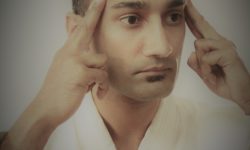
Where the eyes go the body follows, therefore whatever body action you make, do not change your eyes and face from the opponent. From in between the eyes “shoots”
energy, projects, gives direction to your technique. The point between the eyes is called Kami Tan-Den (upper center of energy). The actual eyes are soft, seeing the total
picture, so we have a wide picture and the focus, the soft and the strong. If the eyes don’t give direction, the breath cannot guide the muscles.
The breath activates the feet through the body center to the technique. In order to do that we have to use diaphragmatic breath. Breathing from the chest will activate only
the top muscles.
Good use of the breath is only possible from a good posture, since in a bad posture the muscles are not in optimal length, and the breath is forced, also from a bad posture the
muscles cannot be activated in proper sequence.
Reaction by breath, not by brain
If you walk in the street and a car comes at you surprisingly, you react with the breath, hhaaaa… and jump (before the brain realizes), you don’t look at the car and decide to
be surprised and jump. This is the reaction we use in karate, that’s how we bypass the brain.
The breath control center is in the lower, more primitive part of the brain, an area that has to do more with survival and not conscious. We already explained that the breath
control the muscles and technique, breath makes reaction, breath make action, reaction and action become one without space and the breath is the trigger.
Karate technique should start quickest, without back motion; otherwise it cannot be used in application.
There are two methods to initiate technique quickest without back motion, breath is most essential for both methods.
First, body dynamics such as rotation, and vibration have to initiate not from the hips, not thinking of rotation, but thinking of initiating from the spine which is a smaller
diameter and therefore can be switched quicker expanding less energy to achieve more result, the intention is in the low spine and the breath control the center.
Second, muscle reaction, creating a sling shot within the body, making the preparation internal by using the breath (reverse exhale) to draw the stomach back toward a stable
back and buttocks which are the base. Then switch exhale direction, stimulating the muscles, using muscle reaction from the center, not chest, to drive the technique.
Increase energy
At the end of the technique the forearm twists sharply at the elbow joint as action center (in most cases). The sharp change from straight line to circular action increases energy sharply.
What is important here again is the breath that controls the whole body snap from the ground through the core with the elbow being merely an expression.
Kime (focus, delivery of total energy to target at impact)
Pressure- At contact we don’t rely on muscle strength but rather on skill. If we relied on strength to achieve twice the power we will need to develop twice the muscles.
Instead at impact we create pressure to the floor with the breath. To accelerate the body weight, twice the pressure means twice the body weight as reaction from floor.
As we make pressure we must have strong intention of the reaction of this pressure being delivered to technique direction.
Contraction- as we make pressure to produce energy we need shocking power, meaning all energy delivered in shortest time (avoid pushing power). Therefore we need sharpest contraction of total body musculature in proper sequence (ground to technique in most cases).
Again breathing makes sharp contraction, or slower contraction. As the breath makes pressure, contraction starts from the ground up, but at the same time our intention is of contraction toward the spine. Which then as a chain reaction, and with a stable spine as an anchor, the big muscles are working from the spine to the technique.
Breathing controls type of contraction, type of energy
Depends on the purpose of the technique. If it is sharp shock, heavier target, smooth technique - the breath controls the way the muscles are activated, and make the contraction at Kime.